What Makes Dysfunctions Reflexes Work Again
Reflexes
Jump to:navigation, search
Spinal Reflex/The Reflex Arc [edit | edit source]
Areflex is an involuntary and nearly instantaneous move in response to a stimulus. The reflex is an automatic response to a stimulus that does non receive or need witting thought as it occurs through a reflex arc. Reflex arcs act on an impulse earlier that impulse reaches the brain.[1]
Relex arcs can be
- Monosynaptic ie contain only 2 neurons, a sensory and a motor neuron. Examples of monosynaptic reflex arcs in humans include the patellar reflex and the Achilles reflex.
- Polysynaptic ie multiple interneurons (also called relay neurons) that interface between the sensory and motor neurons in the reflex pathway.[two]
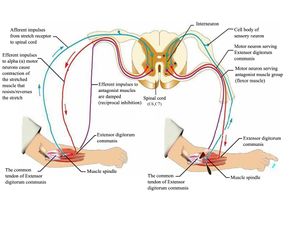 Analogy of the reflex arc.
Video of reflex arc
Types of Reflexe [edit | edit source]
- Superficial reflexes: Plantar response, intestinal reflex, cremastic reflex, corneal reflex[3]
- Deep reflexes: Biceps, Brachioradialis, Triceps, Articulatio genus jerk, and ankle jerk.
Reflex Testing [edit | edit source]
Deep Tendon (muscle stretch) Reflexes [edit | edit source]
Evaluates afferent nerves, synaptic connections within the spinal string, motor nerves, and descending motor pathways. Lower motor neuron lesions (eg affecting the anterior horn cell, spinal root or peripheral nervus) depress reflexes: upper motor neuron lesions increment the reflexes.
Reflexes tested include the following:
- Biceps (innervated past C5 and C6)
- Radial brachialis (by C6)
- Triceps (past C7)
- Distal finger flexors (by C8)
- Quadriceps articulatio genus jerk (by L4)
- Ankle jerk (by S1)
- Jaw jerk (by the 5th cranial nerve)
Technique for testing reflexes [edit | edit source]
- The muscle group to exist tested must be in a neutral position (i.e. neither stretched nor contracted).
- The tendon attached to the musculus(due south) which is/are to exist tested must exist clearly identified. Place the extremity in a positioned that allows the tendon to be easily struck with the reflex hammer.
- To easily locate the tendon, inquire the patient to contract the musculus to which it is fastened. When the muscle shortens, you should be able to both see and feel the string like tendon, confirming its precise location.
- Strike the tendon with a unmarried, brisk, stroke. You lot should not arm-twist pain.
This grading system is rather subjective.
- 0 No evidence of contraction
- 1+ Decreased, simply withal nowadays (hypo-reflexic). Hyporeflexia is by and large associated with a lower motor neuron deficit (at the alpha motor neurons from spinal cord to muscle) eg Guillain–Barré syndrome
- 2+ Normal
- 3+ Super-normal (hyper-reflexic) Hyperreflexia is frequently attributed to upper motor neuron lesions eg Multiple sclerosis
- 4+ Clonus: Repetitive shortening of the muscle later a single stimulation[4]
Notation any asymmetric increase or depression. Jendrassik manoeuvre can be used to broaden hypoactive reflexes ie the patient locks the easily together and pulls vigorously autonomously equally a tendon in the lower extremity is tapped or can button the knees together against each other, while the upper limb tendon is tested.
The video below illustrates the testing of the deep tendon reflexes
[5]
Pathologic reflexes [edit | edit source]
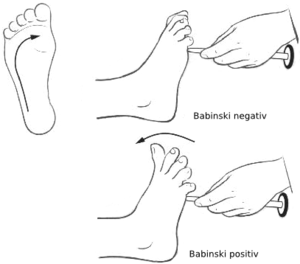
Pathologic reflexes (eg, Babinski, rooting, grasp) are reversions to primitive responses and indicate loss of cortical inhibition.
Other reflexes [edit | edit source]
Clonus (rhythmic, rapid alternation of muscle contraction and relaxation acquired by sudden, passive tendon stretching) testing is done by rapid dorsiflexion of the foot at the talocrural joint. Sustained clonus indicates an upper motor neuron disorder.[6]
Significance of Superficial reflexes in Physiotherapy [edit | edit source]
- Abdominal reflex-is stimulated by stroking around the abdomen which helps in determining the level of CNS lesion.[7]
- Cremastic reflex-It is elicited when the inner part of thigh is stroked in males (Geigel reflex is the counterpart in females). This reflex helps in evaluation of acute scrotal pain and assessing for testicular torsion(associated with loss of reflex)[8].
- Corneal reflex-It is elicited by gentle stroking on the cornea with a cotton fiber swab. This reflex mainly helps in knowing the damage peripherally to either the trigeminal nerve (Five) or facial nervus (VII) nerve volition disrupt the corneal blink circuit. [ix]
- Plantar reflex-abnormal reflex indicates metabolic or structural aberration in the corticospinal system upstream from the segmental reflex.[10]
Reference [edit | edit source]
- ↑ Wikipedia. Reflex. Bachelor from: https://en.wikipedia.org/wiki/Reflex (last accessed 21.4.2019)
- ↑ Lumen. Reflexes. https://courses.lumenlearning.com/boundless-ap/chapter/reflexes/ (concluding accessed 21.iv.2019)
- ↑ http://teachneuro.blogspot.com/2013/01/the-corneal-or-blink-reflex.html?m=1
- ↑ Academy of California. The neurological test. Available from: https://meded.ucsd.edu/clinicalmed/neuro3.htm (last accessed 21.4.2019)
- ↑ Justin Vaida Deep tendon reflexes. Bachelor from: https://world wide web.youtube.com/watch?5=H1b-iKf2CuY (concluding accessed 21.four.2019)
- ↑ MSD Manual. How to access reflexes. Available from: https://www.msdmanuals.com/professional person/neurologic-disorders/neurologic-test/how-to-appraise-reflexes (last accessed 21.four.2019)
- ↑ https://en.wikipedia.org/wiki/Abdominal_reflex
- ↑ https://www.ncbi.nlm.nih.gov/books/NBK513348/#
- ↑ https://www.ncbi.nlm.nih.gov/books/NBK534247/
- ↑ https://www.ncbi.nlm.nih.gov/books/NBK397/
Source: https://www.physio-pedia.com/Reflexes
Belum ada Komentar untuk "What Makes Dysfunctions Reflexes Work Again"
Posting Komentar