Tamayo Birth of Our Nation in Palace of Fine Arts Location
| Rufino Tamayo | |
|---|---|
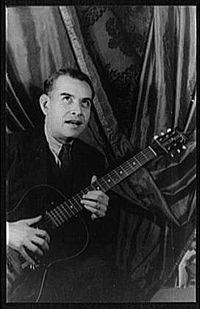 Rufino Tamayo belongings a guitar 1945, | |
| Born | Rufino del Carmen Arellanes Tamayo (1899-08-25)25 Baronial 1899 Oaxaca de Juárez, Mexico |
| Died | 24 June 1991(1991-06-24) (aged 91) Mexico City, Mexico |
| Nationality | Mexican |
| Education | María Izquierdo, José Vasconcelos (National Archaeological Museum) |
| Known for | Painting and Cartoon |
| Notable work | Children Playing with Burn down, Lion and Horse, Animals ,The Window |
| Movement | Modernism |
| Spouse(due south) | Olga Flores |
| Elected | Head of the Section of Ethnographic Drawings, Escuela Nacional de Artes Plasticas, Universidad Nacional Autónoma de México |
| Website | www.rufinotamayo.org.mx/wp |
Rufino del Carmen Arellanes Tamayo (August 25, 1899 – June 24, 1991) was a Mexican painter of Zapotec heritage, born in Oaxaca de Juárez, United mexican states.[1] [two] Tamayo was active in the mid-20th century in Mexico and New York, painting figurative abstraction[3] [4] with surrealist influences.[1]
Early life [edit]
Tamayo was built-in in Oaxaca, Mexico in 1899 to parents Manuel Arellanes and Florentina Tamayo.[5] His female parent was a seamstress and his father was a shoemaker. His mother died of tuberculosis in 1911.[half dozen] His Zapotec heritage is ofttimes cited as an early influence.[three]
After his female parent's death he moved to Mexico City to alive with his aunt, where he spent a lot of time working aslope her in the city'southward fruit markets.[7]
While at that place, he devoted himself to helping his family with their small business organisation. Yet, in 1917 Tamayo's aunt enrolled him at Escuela Nacional de Artes Plásticas at San Carlos to study art.[3] As a pupil, he experimented with and was influenced by Cubism, Impressionism and Fauvism, amid other popular art movements of the time, merely with a distinctly Mexican feel.[3] Although Tamayo studied drawing at the Academy of Art at San Carlos every bit a young adult, he became dissatisfied and eventually decided to written report on his own. That was when he began working for José Vasconcelos at the Department of Ethnographic Drawings (1921); he was later appointed head of the section by Vasconcelos.[ commendation needed ]
Career [edit]

Homenaje al Sol (Tribute to the Sun). The intention of this piece of work was to honor the nomads and natives of the Northeast who considered the Sun every bit a god.
Rufino Tamayo, along with other muralists such as Rivera, Orozco and Siqueiros, represented the twentieth century in their native state of Mexico.[8] Later the Mexican Revolution, Tamayo devoted himself to creating a distinct identity in his work. He expressed what he envisioned as the traditional Mexico and eschewed the overt political art of such contemporaries as José Clemente Orozco, Diego Rivera, Oswaldo Guayasamín and David Alfaro Siqueiros. He disagreed with these muralists in their belief that the revolution was necessary for the future of Mexico just considered, instead, that the revolution would impairment Mexico.
In his painting, Niños Jugando con Fuego (Children Playing with Fire, 1947), Tamayo shows two individuals being burnt by a fire they have created, a symbol of the Mexican people being injured by its own pick and activity.[9] Tamayo claimed, "Nosotros are in a dangerous situation, and the danger is that man may be absorbed and destroyed past what he has created". Due to his political opinions, he was characterized by some equally a "traitor" to the political cause.[ citation needed ]
Tamayo came to feel that he could non freely express his art; he therefore decided in 1926 to leave United mexican states and motion to New York City. Prior to his deviation, Tamayo organized a ane-homo bear witness of his piece of work in Mexico City where he was noticed for his individuality.[iii] He returned to United mexican states in 1929 to have another solo testify, this time being met with loftier praise and media coverage.[ citation needed ]

Tamayo's legacy in the history of fine art lies in his oeuvre of original graphic prints in which he cultivated every technique. Tamayo's graphic work, produced between 1925 and 1991, includes woodcuts, lithographs, etchings and "Mixografia" prints. With the assist of Mexican printer and engineer Luis Remba, Tamayo expanded the technical and aesthetic possibilities of the graphic arts by developing a new medium which they named Mixografia. This technique is a unique fine fine art printing process that allows for the production of prints with three-dimensional texture.[10]
It non but registered the texture and book of Rufino Tamayo's blueprint just also granted the artist liberty to utilize any combination of solid materials in its creation. Tamayo was delighted with the Mixografia process and created some eighty original Mixographs. 1 of their most famous Mixografia is titled Dos Personajes Atacados por Perros (Two Characters Attacked by Dogs).[eleven]
In 1935, he joined the Liga de Escritores y Artistas Revolucionarios (LEAR). The LEAR was an organisation in which Mexican artists could express through painting and writing their responses towards the revolutionary state of war and governmental policies and so electric current in Mexico. Although Tamayo did not agree with Siqueiros and Orozco, they were chosen forth with four others to represent their art in the first American Artists' Congress in New York. Now married, Rufino and Olga had planned on staying in New York only for the elapsing of the consequence; however, they made New York their permanent abode for the next decade and a half.[12]
In 1948, Tamayo's first major retrospective was held at the Palacio de Bellas Artes in Mexico City. Although his positions remained controversial, his popularity was high. Uncomfortable with the continuing political controversy, Tamayo and Olga moved to Paris in 1949 where they remained for the next decade.[iii]
Tamayo also enjoyed portraying women in his paintings. His early on works included many nudes, a subject which somewhen disappeared in his later career. However, he often painted his wife Olga, showing her struggles through color choices and facial expressions. The shared difficulties of painter and wife can be seen in the portrait Rufino and Olga, circa 1934, where the couple appears broken by life's obstacles.
Tamayo besides painted murals, some of which are displayed inside Palacio Nacional de Bellas Artes opera business firm in Mexico City, such as Nacimiento de la nacionalidad (Birth of the Nationality, 1952).
Tamayo was known to have a couple protégé who he privately taught. Francisco Toledo & Veronica Ruiz de Velasco who were both in the National Museum of Modern Art.
Influences [edit]

Tamayo was influenced past many artists. María Izquierdo, a fellow Mexican artist with whom he lived with for a time, taught Tamayo precision in his color choices. He selected colors true to his Mexican environment. He argued, "Mexicans are not a gay race but a tragic ane ..."[thirteen]
Other influences came from Tamayo's cultural heritage. One tin say that Tamayo was one of the few artists of his era who enjoyed Mexico's indigenous differences. He enjoyed the fusion of Spanish-Mexican-Indian blood and that is shown in some of his fine art pieces. In Lion and Horse (1942), Tamayo used pre-Columbian ceramics.[13] Tamayo was proud of his Mexican civilization because his culture nourished him and, by traveling to other countries, his love for Mexico became greater.[9]
Tamayo's acute awareness of the disregard shown Mexican artists influenced him greatly. For case, according to Jose Carlos Ramirez, "Tamayo's piece of work did non have much value".[14] Many people doubted that Mexican artists could actually create art. Under the Díaz regime, artists of Mexican origin were ignored by society; information technology was commonly held that they lacked the skills to surpass artists of European descent.
Outside Mexico [edit]
From 1937 to 1949, Tamayo and his married woman Olga lived in New York where he painted some of his most memorable works. He had his first bear witness in New York City at the Valentine Gallery. He gained credibility thereby and proceeded to exhibit works at the Knoedler Gallery and Marlborough Gallery. While in New York, Tamayo instructed Helen Frankenthaler at the Dalton School[15] Tamayo, while in the United States, attended important exhibitions which influenced his art mechanics. From Ingres to Picasso and French art exhibitions, Tamayo was introduced to Impressionism, Fauvism, and Cubism. As well, at an exhibition in Brooklyn in 1928, Tamayo came into contact with Henri Matisse, the French artist.[nine]
In a 1926 exhibition, 39 of Tamayo's works were displayed at the Weyhe Gallery in New York just a month later on his arrival into the United States. This stands in stark contrast to the few showings which were held during his early on career in México.[12] The artist'due south sojourn in New York dramatically increased his recognition not simply in the U.s. but in Mexico and other countries also.
Style [edit]

Tamayo explained his approach to Paul Westheim as follows: "As the number of colors we apply decreases, the wealth of possibilities increases". Tamayo favored using few colors rather than many; he asserted that fewer colors in a painting gave the art greater force and pregnant. Tamayo'southward unique color choices are evident in the painting Tres personajes cantando (Iii singers), 1981. In this painting, Tamayo employs pure colors such as cherry-red and purple; his restraint in the pick of color here confirms his belief that fewer colors, far from limiting the painting, actually enlarge the composition's possibilities.[sixteen] With that existence said, Octavio Paz, author of the book Rufino Tamayo, argues that, "Time and once more we have been told that Tamayo is a cracking colourist; but it should be added that this richness of colour is the event of sobriety". By being pure or, as Paz explained, sober with his color choice, Tamayo's paintings were enriched, not impoverished.[17]
If I could express with a single word what it is that distinguishes Tamayo from other painters, I would say without a moment'south hesitation: Sun. For the sun is in all his pictures, whether we see it or not.
Listing of artworks [edit]
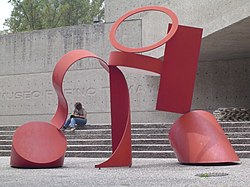
Entrance to museum Rufino Tamayo in Mexico.

Mario Moreno "Cantinflas" by Rufino Tamayo, 1948, exhibition "The Collection of Mexican Painting by Jacques and Natasha Gelman"[xviii] affiche, 1992, Cultural Center of Contemporary Art (defunct) City of Mexico.
- Untitled (1926)
- Cabeza mujer (1927)
- Mujeres con rebozo (1927)
- Still life with corn (1928)
- Naturaleza muerta con pie (1928)
- Notwithstanding Life (1928)
- Interior with an alert clock showing four:47 PM on the night table (1928)
- Frutero Y Domino (1928)
- The Window(1932)
- Rufino and Olga (1934)
- Two Bathers (1934)
- Animals (1941)
- Lion and Horse (1942)
- Adult female Spinning (1943)
- Children Playing with Fire (1947)
- Nacimiento de nuestra nacionalidad (1952)
- Mexico de Hoy (1953)
- El día y la noche (Twenty-four hours and Night) (1954)
- Naturaleza muerta (1954)
- America (1955)
- Matrimonio (1958)
- El Perro en la Luna (The Canis familiaris on The Moon) (1973)
- Watermelons (1977)
- Tres personajes cantando (Iii Singers) (1981)
- Hombre con flor (Man with Flower) (1989)
- Luna y Sol (Moon and Sun) (1990)
Return dwelling house and later years [edit]

In 1959, Tamayo and his wife, Olga Flores, returned to United mexican states permanently and Tamayo built an art museum in his domicile boondocks of Oaxaca, the Museo Rufino Tamayo. In 1972, Tamayo was the subject of the documentary motion-picture show, Rufino Tamayo: The Sources of his Art by Gary Conklin.
The Tamayo Contemporary Art Museum (Museo Tamayo de Arte Contemporáneo), located on Mexico City's Paseo de la Reforma boulevard where it crosses Chapultepec Park, was opened in 1981 as a repository for the collections that Rufino Tamayo and his wife acquired during their lifetimes, and ultimately donated to the nation. Tamayo painted his last painting in 1990, at the historic period of 90, Luna y Sol (Moon and Sun).
Tamayo'south work has been displayed in museums throughout the earth, including the Solomon R. Guggenheim Museum in New York City, The Phillips Collection in Washington, the Cleveland Museum of Art in Cleveland, Ohio, the Naples Museum of Art in Naples, Florida, Oklahoma City Museum of Art in Oklahoma Urban center, Oklahoma and The Museo Nacional Centro de Arte Reina Sofia in Madrid, Kingdom of spain.
Death [edit]
On June 12, 1991, Tamayo was admitted to Mexico Urban center'south National Found of Medical Sciences and Nutrition for respiratory and heart failure. He suffered a heart assail and died on June 24, 1991.
Before his death, Tamayo continued creating art pieces in his late years. He was very productive at that stage in life. There were several important exhibitions and publications organized afterward his expiry.[xvi]
Theft and recovery [edit]
Tamayo's 1970 painting Tres Personajes was bought by a Houston human being equally a gift for his married woman in 1977, and then stolen from their storage locker in 1987 during a movement. In 2003, Elizabeth Gibson found the painting in the trash on a New York Metropolis curb.[19] Although she knew little about modern art, Gibson felt the painting "had power" and took it without knowing its origin or market value. She spent 4 years trying to learn nigh the piece of work, somewhen learning from the PBS website that information technology had been featured on an episode of Antiques Roadshow. After seeing the Missing Masterpieces segment nearly Tres Personajes, Gibson and the sometime owner arranged to sell the painting at a Sotheby's auction. In Nov, 2007 Gibson received a $15,000 reward plus a portion of the $1,049,000 sale sale price.[19] [20] [21]
Recognitions [edit]
- National Prize for Arts and Sciences in Fine Arts of Mexico, 1964
- Honorary Doc by the National Academy of Mexico,[22] 1978
- Honorary Doctor of Fine Arts by the Academy of Southern California,[23] 1985
- Gold Medal of Merit in the Fine Arts of Spain, 1985
- Belisario Domínguez Medal of Honor by the Mexican Senate, 1988
- Thou Officer of the Order of Merit of the Italy, 1989
- Honorary member of the National College of United mexican states, 1991
Exhibitions and retrospectives [edit]
Tamayo: The New York Years, Smithsonian American Art Museum 2017–2018[24]
Run across also [edit]
- Acapantzingo, Cuernavaca
- List of people from Morelos, United mexican states
- Museo Rufino Tamayo, Mexico City
- Museo Rufino Tamayo, Oaxaca
Citations [edit]
- ^ a b Sullivan, 170-171
- ^ Ades, 357
- ^ a b c d due east f Carlos Suarez De Jesus (2007). "Mexican Master". The Miami New Times . Retrieved October one, 2007.
- ^ The Adani Gallery (2007). "Rufino Tamayo". The Adani Gallery. Retrieved October 1, 2007.
- ^ Ruiz, Elisa (26 Baronial 2018). "Hace 119 años nació Rufino Tamayo en el barrio del Carmen Alto". Sucedió en Oaxaca (in Spanish). Retrieved 6 July 2019.
- ^ SUCKAER, INGRID. "Rufino Tamayo Cronología" (PDF). Oficina de Derechos de Autor Rufino Tamayo . Retrieved half-dozen July 2019.
- ^ "Rufino Tamayo Essay | past William Sheehy". www.latinamericanmasters.com. Retrieved 2018-05-19 .
- ^ Nicoletta, Julie. "Fine art OUT OF Place: INTERNATIONAL Fine art EXHIBITS AT THE NEW YORK WORLD'S FAIR OF 1964-1965". Peter Due north. Stearns. ProQuest 850495862.
- ^ a b c 24-hour interval], Holliday T. Day and Hollister Sturges ; with contributions by Edward Lucie-Smith, Damián Bayón ; [edited by Sue Taylor ; boosted editing by Anna Baker ... et al. ; translations by Michele Davis, Linda Huddleston, Susan; et al. (1987). Art of the fantastic : Latin America, 1920-1987 (1st ed.). Indianapolis, Ind.: Indianapolis Museum of Fine art. ISBN0-936260-19-10.
- ^ Frank Houston (2007). "Gone Tamayo". The Miami New Times . Retrieved October 1, 2007.
- ^ "Rufino Tamayo". Artscene. 2007. Retrieved Oct 1, 2007.
- ^ a b Ittmann, John, ed. (2006). Mexico and modernistic printmaking : a revolution in the graphic arts, 1920 to 1950. Philadelphia, Pa.: Philadelphia Museum of Art [u.a.] ISBN0-87633-195-nine.
- ^ a b Lucie-Smith, Edward (2005). Latin American art of the 20th century (Rev. and expanded ed.). London: Thames & Hudson. ISBN0-500-20356-iii.
- ^ Ramirez, Jose Carlos (2008). Competencia por cantidad en los mercados de arte de Mexico. Mexico: Fondo de cultura economica. ProQuest 220818238.
- ^ Katherine Jentleson (November 21, 2007). "Artist Dossier: Rufino Tamayo". ARTINFO. Archived from the original on April 23, 2008. Retrieved 2008-04-28 .
- ^ a b Long, Andrew; Panichi, Luisa (2000). Teresa del Conde (ed.). Tamayo (1st U.S. ed.). Boston: Little, Brown. ISBN0-8212-2651-7.
- ^ Lyons], texts by Octavio Paz, Jacques Lassaigne ; translated past Kenneth (1995). Rufino Tamayo ([second updated ed.]. ed.). Barcelona: Ediciones Polígrafa. ISBN84-343-0795-two.
- ^ Run across Jacques Gelman
- ^ a b ULA ILNYTZKY (23 October 2007). "Painting found in trash could fetch $1M". United states of america Today. Associated Printing.
- ^ Charlotte Higgins (24 October 2007). "Stolen masterpiece found on New York street". The Guardian. London.
- ^ Lisa Gray (Nov 6, 2007). "Finding Tamayo painting was outcome of fate". Houston Chronicle . Retrieved 2007-eleven-21 .
- ^ "Honorary doctorates past the National University of Mexico (spanish)". Archived from the original on 2014-02-25.
- ^ "University of Southern California Outset 1985". Los Angeles Times. 1985. Retrieved August 11, 2013.
- ^ "SAAM - Tamayo: The New York Years". November 9, 2017.
General references [edit]
- Ades, Dawn. Fine art in Latin America: The Modern Era 1820–1980. New Oasis: Yale University Press, 2006. ISBN 978-0-300-04561-i.
- Matheos, José Corredor. Tamayo. New York: Rizzoli, 1987. ISBN 978-0-8478-0855-seven.
- Sullivan, Edward J. The Language of Objects in the Art of the Americas. New Haven: Yale Academy Press, 2007. ISBN 978-0-300-11106-4.
Further reading [edit]
- Conde, Teresa del; Tamayo, Rufino (2000). Tamayo. Boston: Little, Brown. ISBN0-8212-2651-7.
- DuPont, Diana C., ed. Tamayo: A Modern Icon Revisited. Santa Barbara: Santa Barbara Museum of Art 2007.
- DuPont, Diana C.; Mary K. Coffey; Rufino Tamayo; Museo Rufino Tamayo; Santa Barbara Museum of Art; Miami Art Museum (2006). Tamayo, a Modern Icon Reinterpreted. Santa Barbara, Calif. in association with Editorial Turner de México: Santa Barbara Museum of Art. ISBN84-7506-745-X.
{{cite book}}: CS1 maint: multiple names: authors list (link) - Rufino Tamayo: seventy años de creación. 2 vols. Mexico Urban center: MPBA/Museo Tamayo 1987.
External links [edit]
- New York Times obituary
- Sotheby's: From The Trash Bin To The Auction Block
- Museo Tamayo (in Spanish)
- Rufino Tamayo: Life, biography and paintings (in French)
- Rufino Tamayo: The Sources of his Fine art (documentary)
- "Miami Museum of Fine art (MAM) Tamayo Exhibition (June 24th–Sept 23rd, 2007)"
- 1 Person's Trash Is Another Person'due south Lost Masterpiece, New York Times
Source: https://en.wikipedia.org/wiki/Rufino_Tamayo
Belum ada Komentar untuk "Tamayo Birth of Our Nation in Palace of Fine Arts Location"
Posting Komentar