Showers
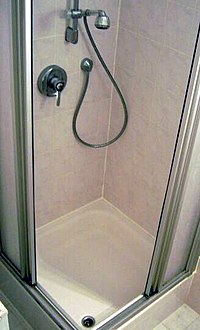

A combination shower and bathtub, with movable screen
A shower is a place in which a person bathes under a spray of typically warm or hot water. Indoors, there is a bleed in the floor. Most showers accept temperature, spray pressure level and adaptable showerhead nozzle. The simplest showers accept a swivelling nozzle aiming down on the user, while more complex showers have a showerhead continued to a hose that has a mounting subclass. This allows the showerer to concur the showerhead by hand to spray the h2o onto different parts of their body. A shower can exist installed in a small shower stall or bathtub with a plastic shower mantle or door. Showering is common in Western culture due to the efficiency of using it compared with a bathtub. Its use in hygiene is, therefore, common exercise.[i] [ folio needed ]
History
The original showers were neither indoor structures nor man-made but were common natural formations: waterfalls.[2] The falling h2o rinsed the bathers completely clean and was more efficient than bathing in a traditional bowl, which required manual transport of both fresh and waste product water. Aboriginal people began to reproduce these natural phenomena by pouring jugs of water, ofttimes very cold, over themselves after washing. There has been evidence of early on upper course Egyptian and Mesopotamians having indoor shower rooms where servants would bathe them in the privacy of their ain homes.[3] Nevertheless, these were rudimentary by mod standards, having rudimentary drainage systems and water was carried, non pumped, into the room. The ancient Greeks were the first people to take showers. Their aqueducts and sewage systems made of lead pipes allowed water to exist pumped both into and out of large communal shower rooms used by elites and common citizens alike.[4] These rooms take been discovered at the site of the city Pergamum and can also be establish represented in pottery of the era. The depictions are very like to modern locker room showers, and even included bars to hang up clothing.[five] [ page needed ] The ancient Romans also followed this convention; their famous bathhouses (Thermae) can be plant all around the Mediterranean and as far out as mod-day England. The Romans non just had these showers simply also believed in bathing multiple times a week, if not every 24-hour interval. The water and sewage systems developed past the Greeks and Romans bankrupt down and fell out of apply after the fall of the Roman Empire.
Modern showers
The starting time mechanical shower, operated by a paw pump, was patented in England in 1767 by William Feetham,[ citation needed ] a stove maker from Ludgate Hill in London. His shower contraption used a pump to force the water into a vessel above the user's head and a chain would then be pulled to release the water from the vessel. Although the system dispensed with the servant labour of filling upwardly and pouring out buckets of water, the showers failed to catch on with the rich as a method for piping hot water through the system was non available. The system would also recycle the aforementioned dirty water through every cycle.
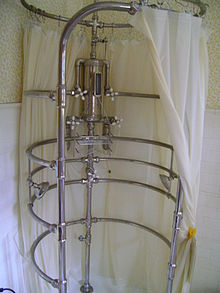
This early get-go was profoundly improved in the anonymously invented English Regency shower design of circa 1810 (in that location is some ambiguity among the sources).[2] The original pattern was over 10 feet (iii thou) alpine, and was made of several metal pipes painted to wait like bamboo. A basin suspended to a higher place the pipes fed water into a nozzle that distributed the water over the user'south shoulders. The water on the ground was drained and pumped dorsum through the pipes into the bowl, where the bike would repeat itself.[ citation needed ] The original image was steadily improved upon in the post-obit decades until it began to approximate the shower of today in its mode of operation. Manus-pumped models became fashionable at one indicate too equally the use of adjustable sprayers for different h2o period. The reinvention of reliable indoor plumbing effectually 1850[6] immune free-standing showers to be continued to a running water source, supplying a renewable flow of h2o.[ citation needed ] Modernistic showers were installed in the barracks of the French ground forces in the 1870s as an economic hygiene measure, under the guidance of François Merry Delabost, a French doctor and inventor.[7] As surgeon-full general at Bonne Nouvelle prison house in Rouen, Delabost had previously replaced individual baths with mandatory communal showers for use by prisoners, arguing that they were more economical and hygienic.[eight] First six, then viii shower stalls were installed. The water was heated by a steam engine and in less than five minutes, up to eight prisoners could wash simultaneously with only twenty litres of water. The French system of communal showers was adopted past other armies, the first existence that of Prussia in 1879, and by prisons in other jurisdictions. They were also adopted by boarding schools, earlier existence installed in public bathhouses. The beginning shower in a public bathhouse was in 1887 in Vienna. In French republic, public bathhouses and showers were established by Charles Cazalet, firstly in Bordeaux in 1893 and and so in Paris in 1899.[ix]
Types
Domestic
Domestic showers are most commonly stall showers or showers combined with a bathtub. A stall shower is a dedicated shower area which uses a door or curtain to comprise water spray. The shower/tub format saves bathroom space and enables the area to exist used for either a bath or a shower and commonly uses a sliding shower curtain or door to contain the water spray. Showers may also be in a moisture room, in which there is no contained shower area, or in a dedicated shower room, which does not require containment of water spray. Domestic showers can take a single shower head, multiple shower heads, handheld shower head(southward) or other variations, all which may exist adaptable as needed to varying degrees.
Public

Many modern athletic and aquatic facilities provide showers for use by patrons, unremarkably in gender segregated changing rooms. These tin can exist in the form of individual stalls shielded by curtains or a door or communal shower rooms. The latter are generally big open rooms with whatever number of shower heads installed either directly into the walls or on posts throughout the shower area. Open showers are often provided at public pond pools and at popular beaches. Military forces effectually the globe set up field showers to enable the washing away of unsafe residual from modern weapons such as caustic chemicals, mortiferous biological agents, and radioactive materials, which can harm forces on both sides of a conflict.[ten]
Wet room
A wet room often refers to a bathroom without internal dedicated or raised areas which has an open shower. Structurally, a moisture room requires the bathroom to have a gradient or slope towards a drain hole, and a foul air trap connecting the floor to the waste pipes. Depending on region, the term moisture room can besides embrace other rooms such as laundry rooms. In Kingdom of norway, for example, whatsoever room with tap water and a drain in the floor is considered a wet room. Different jurisdictions often have special regulations concerning the design and construction of wet rooms to prevent damages from damp air or h2o leakage, due east.g. mold. There are besides oft special regulations concerning electrical installations in wet rooms. For case, since water supplies frequently accept their own electrical grounding, there tin can exist an added hazard of injury associated to footing-faults, and some jurisdictions therefore require the installation of rest-current devices in wet rooms.
Other
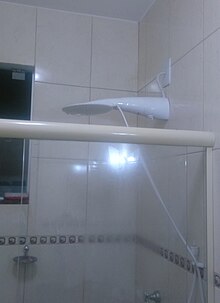
Brazilian electric shower
- Air shower, a type of bathing where high pressure level air is used to blow off excess dust particles from cleanroom personnel.
- Digital shower, a shower system that works in a like way to mixer or power showers, just provides more command over the temperature of the water with the use of a digital control panel.
- Eco shower, a shower system that comes in mixer or electric variations, simply also features a regulator to regulate the menstruum of water with a view to saving water.
- Electric shower, a shower stall device to locally heat shower water with electrical ability.
- Emergency showers, installed in laboratories and other facilities that use chancy chemicals, are required by law in the United States;[xi] designed to drench continuously at around thirty–60 United states gallons (110–230 l) per infinitesimal [12] for at least fifteen minutes [13] and should be located at virtually ten seconds away from potential users.[14]
- Mixer shower, a shower organisation that takes h2o from existing hot and cold water supplies and combines them within the unit.
- Navy shower, a method of showering that allows for significant conservation of water and energy.
- Power shower, a shower stall device that works similarly to a mixer shower by mixing existing hot and cold water feeds, only locally increases the water force per unit area available to the shower head past means of an electrical booster pump.
- Roman shower, a shower that does not use a door or curtain.
- Steam shower, a type of bathing where a humidifying steam generator produces steam that is dispersed around a person'southward torso.
- Vichy shower, a shower where large quantities of warm water are poured over a spa patron while the user lies inside a shallow (wet) bed, similar to a massage table, simply with drainage for the water.
Types of shower heads
- Fixed shower heads: Traditional fixed shower-heads are mostly common shower-faucets because they can easily connect to the plumbing equipment without whatsoever boosted hardware.
- Shower handsets: Hand-fix shower-faucets are connected past a flexible hose, and can also be mounted and used like a fixed shower-head.
- Ceiling-mounted faucets: Ceiling-mounted shower-faucets are typically rain-drop shower-heads mounted in the ceiling of the shower. Water rains down, at low or medium pressure, using gravity to shower on ane from directly above.[15]
- Adjustable shower heads: Adjustable shower faucets often have numerous settings, including pulsating massage and low/medium/loftier-pressure catamenia settings.
- Shower panels: Unlike a unmarried showerhead, these are wall-mounted with sprayers aimed horizontally at various parts of the body.
Use and environmental

Shower usage in the latter half of the 20th century skyrocketed. Personal hygiene became a primary concern, and bathing every mean solar day or multiple times a twenty-four hour period is common amongst Western cultures.[1] [ page needed ] Showering is generally faster than bathing and tin can use less water. In an average habitation, showers are typically the third largest h2o use after toilets and clothes washers. The average American shower uses 17.ii Usa gallons (65 l; 14.3 imp gal) and lasts for eight.2 minutes at an average catamenia rate of ii.1 Usa gallons (7.9 l; one.vii imp gal) per minute.[sixteen] Showering is one of the leading ways people use h2o in the habitation, accounting for nearly 17 percent of residential indoor water use, which roughly equals to 1,200,000,000 US gallons (4.5×10nine l; i.00×10nine imp gal) of water annually just for showering.[17] The U.S. Environmental Protection Agency recommends to retrofit home showers with a shower head that uses less than 2 Us gallons (7.6 l; one.7 imp gal) to conserve water. All the same, many have hypothesized reducing flow rates of showerheads might cause users to take much longer showers.[xviii] Other options to salve water include using extra high pressure mist menses or design in sensors and valves to close off or reduce h2o flow while people are not actively using the shower water.
Various measures can be taken to increase safety for those, particularly elderly people, taking showers or baths.[19] When a person takes a shower may betoken their social position. Blue collar workers and children have been institute to be more likely to take a shower in the evening after work and school, whereas white collar workers have been found to shower in the morning before piece of work.[ citation needed ] Some people take more than one shower each mean solar day, normally at their normal shower fourth dimension, and after exercising. People likewise shower to cool off in hot weather, especially those unaccustomed to the climate.[20] [ ameliorate source needed ] Used shower h2o can exist employed every bit greywater.
Cultural significance
Showering is more often than not role of a daily routine primarily to promote cleanliness and prevent olfactory property, disease and infection. Advances in scientific discipline and medicine in the 19th century began to realize the do good of regular bathing to an individual'due south wellness. As a outcome, most modernistic cultures encourage a daily personal hygiene regimen. Showering has also developed the reputation equally a relaxing and more often than not therapeutic activity.[1] [ page needed ]
Construction and blueprint

Repairing damaged tile in a shower stall with a caulking gun
Designs for shower facilities vary by location and purpose. There are complimentary-standing showers, but also showers which are integrated into a bathtub. Showers are separated from the surrounding expanse through watertight defunction (shower curtain), sliding doors, or folding doors, or shower blinds, in society to protect the space from spraying water. Showers with a level entry wet room are becoming very popular, peculiarly due to improvements in waterproofing systems and prefabricated components. Places such as a swimming pool, a locker room, or a military facility have multiple showers. There may be communal shower rooms without divisions, or shower stalls (typically open at the elevation). Many types of showers are bachelor, including consummate shower units which are all encompassing showers that include the pan, walls, and oftentimes the shower head, every bit well every bit pieced together units in which the pan, shower caput, and doors are purchased separately. Each type of shower poses different installation problems.
Installation
Though the installation requirements of each of shower will differ, the installation of a shower in full general requires the laying of several water transportation pipes, including a pipage for hot water and for common cold h2o, and a drainage pipage. It is of import that the wet areas of a bath exist waterproof, and multiple layers of waterproofing can exist employed. Grout is used to fill gaps between tiles, simply grout and tile setting materials are mostly porous. Tiles are generally waterproof, though a shower pan must exist installed below them every bit a safety to prevent water leakage.[21] Thus small mosaic tiles offer less of a defense than large format tiles. Sub-tile waterproofing is important when tiles are beingness used. Best practice requires a waterproofing material to embrace the walls and floor of the shower surface area that are then covered with tile, or in some countries with a sheet material like vinyl.
Drainage

Shower repair showing drain piping with trap

This diverter valve about to exist installed behind a shower mixes hot and common cold water.
A shower may be equipped with a 2nd emergency bleed outside of the shower in instance of overflow. An emergency overflow drain is required in Australia and some European countries.[ commendation needed ]
Shower head
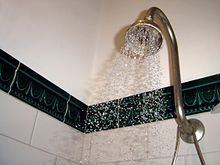
A shower head is a perforated nozzle that distributes h2o over solid bending a focal point of use, by and large overhead the bather. A shower uses less water than a full immersion in a bath. Some shower heads can be adapted to spray dissimilar patterns of h2o, such equally massage, gentle spray, strong spray, and intermittent pulse or combination modes. Hard water may result in calcium and magnesium deposits clogging the head, reducing the period and changing the spray design. For descaling, various acidic chemicals or brushes can be used or some heads take rubber-like jets that can be manually descaled. A homemade remedy is to immerse it in a solution of h2o and vinegar for a while, since the vinegar is able to dissolve limescale. Some governments around the earth set standards for water usage and regulate shower heads. For example, in the United States, residential and well-nigh commercial shower heads must flow no more than 9.5 litres (2.1 imp gal; 2.5 US gal) per minute per the Department of Energy ruling 10 CFR 430. Low-flow shower heads that have a water flow of equal or less than 7.6 litres (ane.seven imp gal; 2.0 Us gal) per minute (2.0 gallons per minute), can use water more efficiently by aerating the water stream, altering nozzles through advanced flow principles or by high-speed oscillation of the spray stream. The US EPA administers a voluntary water saving plan, WaterSense, which can certify low-menstruum shower heads.
Shower and bathtub curtains
Curtains can be used in shower or bathtub enclosures with two main purposes: to provide privacy and to foreclose water from flooding or spraying outside the shower or bathtub area. Shower and bathtub curtains usually surround the bath inside the tub or shower area and are held up with railings or pall rods high on the wall or ceiling. To conform the different types of bathtub shapes, railings tin can come in different sizes and are flexible in their pattern.
Some people use two shower curtains: one that is within the tub, which is mainly functional or decorative likewise, and an outer shower curtain, which is purely decorative. The bottom portion of the inner curtain oftentimes comes with magnetic discs or suction cups which adhere to the bathtub itself.
These curtains are usually made from vinyl, cloth or plastic.
-
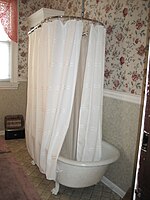
Bathtub curtain
-

Shower mantle
Shower and bathtub doors
Shower or bathtub doors are doors (also chosen screens) used in bathrooms that assist continue water inside a shower or bathtub and are alternatives to shower curtains. They are available in many different styles such as framed or frameless, sliding or swing. They are commonly synthetic of aluminium, clear glass, plexiglass or tempered glass. Shower doors can come up in many different hardware finishes and glass patterns that can friction match other bath hardware such as faucets and shower heads. At that place are also shower doors that are in a neo angle pattern for employ on shower pans that have the neo blueprint likewise. The design of the shower pan is extremely important as the shower door must be the type required for the pan in order to piece of work. A shower door requires plastic lining forth the edges of the door to protect against water leaking out.
-

-

Bathtub door.
Equipment
- Pressure balanced valve, a device to provide abiding shower water pressure and preclude temperature fluctuations
- Shampoo
- Shower caddy, a storage system within the shower, typically for shampoo, conditioner, lather and other related things
- Shower cap, a cap worn while showering or bathing, to protect hair from becoming wet
- Shower radio, a radio that is waterproofed to let it to be used in a bathroom or other wet environment
- Shower speaker, a petty Bluetooth speaker designed to mind to music while showering
- Soap
- Washing mitt, a tool for applying soap to the trunk
- Water oestrus recycling units to reclaim much of the waste product water's heat and recycle it to the shower head and minimize rut lost to the drain
Run across also
- Bathing
- Bathroom
- Bathtub
- Douche
- Navy shower
- Solar heated shower
- Steam shower
- Transfer bench
- Water recycling shower
Citations
- ^ a b c Shove 2004.
- ^ a b "The Stand up-Up Bathroom". theplumber.com. Archived from the original on 30 Nov 2010. Retrieved v Dec 2010.
- ^ James & Thorpe 1995, p. 460.
- ^ Humphrey, Olsen & Sherwood 1998, p. 280.
- ^ James & Thorpe 1995.
- ^ "History of Plumbing in America". Plumbing & Mechanical Mag. July 1987. ISSN 8750-6041. Archived from the original on 6 Nov 2008. Retrieved 6 January 2011.
by 1845, the installation of sanitary sewers began to pay off ... In 1874, ... an unknown plumber solved the problem of venting.
- ^ British indian ocean territory, Roger (2005). Fameux Rouennais, Rouennais fameux. Rouen: PTC-Normandie. ISBN9782350380117.
- ^ Hervé Dajon, La douche, une invention d'united nations médecin des prisons, le docteur Merry Delabost, Criminocorpus, 2010 Online text - in French
- ^ Feltgen, Dr. (eight Nov 2000). "Dr. Merry Delabost, inventor of the shower?" (PDF). Hopitaux de Rouen. Archived from the original (PDF) on 12 January 2012. Retrieved 30 September 2012.
- ^ Jones 2004.
- ^ "1910.151: Occupational Safety and Health Standards — Medical services and first assist". Regulations (Standards - 29 CFR). Occupational Safety and Health Administration. 18 June 1998. Retrieved 1 June 2010.
- ^ Mayer 1995, p. 155.
- ^ Vincoli 2000, p. 343.
- ^ Brauer 2006, p. 533.
- ^ Rowan, Gerald; Sanford, Steve (2013). Compact Houses: 50 Artistic Flooring Plans for Efficient, Well-Designed Pocket-sized Homes. North Adams, Mass.: Storey Publishing. p. x. ISBN9781612121024.
- ^ "Indoor Water Use". Alliance for Water Efficiency. Alliance for Water Efficiency. Archived from the original on 2018-x-24. Retrieved 30 October 2018.
- ^ "Showerheads". Usa Environmental Protection Agency. Retrieved 30 October 2018.
- ^ "Indoor H2o Use". Alliance for Water Efficiency. Archived from the original on 2018-10-24. Retrieved xxx October 2018.
- ^ Mullick 2005.
- ^ Take A Common cold Shower To Cool Off This Summer Archived 2012-11-08 at the Wayback Machine, John Westenhaver, Energy Watcher, 20 June 2009
- ^ "Curbless Showers - An Installation Guide" (PDF). NC Land University. Retrieved 18 January 2017.
Cited works and general references
- Books
- Brauer, Roger L B (2006). "Personal protective equipment". Safety and health for engineers (2d ed.). John Wiley and Sons. ISBN978-0-471-29189-3.
- Humphrey, John W; Olsen, John P; Sherwood, Andrew N (1998). Greek and Roman Technology: A Sourcebook. New York: Routledge. ISBN978-0-415-06136-0.
- James, Peter; Thorpe, Nick (1995). Ancient Inventions . New York: Ballantine. ISBN978-0-345-40102-1.
- Mayer, Leonard (1995). "Emergency systems". Design and planning of research and clinical laboratory facilities. John Wiley and Sons. ISBN978-0-471-30623-8.
- Oxford New Desk Dictionary and Thesaurus (3rd ed.). New York: Berkley Publishing Group. 2009. ISBN978-0-425-22862-3. OCLC 276819901.
- Shove, Elizabeth (2004). Condolement, Cleanliness and Convenience The Social Organization of Normality (New Technologies/New Cultures). New York: Berg. ISBN978-i-85973-630-2.
- Vincoli, Jeffrey W (2000). Lewis' lexicon of occupational and environmental prophylactic and health . CRC Press. ISBN978-1-56670-399-4.
- Web pages
- Jones, Jerry (29 October 2004). "Decontamination shower system revamped". Reporter. Nashville, TN: Vanderbilt Academy Medical Center. Retrieved five December 2010.
- Mullick, Abir (2005). "Bathing for Older people with Disabilities". UB Schoolhouse of Compages and Planning. Retrieved 5 December 2010.
Source: https://en.wikipedia.org/wiki/Shower
Belum ada Komentar untuk "Showers"
Posting Komentar